Showing posts with label Travels. Show all posts

Monday, 16 January 2012

Greetings


Launched in the early 1970s Pioneer 10 and 11 were appropriately named - becoming the first spacecraft to travel through the asteroid belt, first to fly by Jupiter and Saturn, and the first human artifacts to venture beyond the solar system. Now coasting through interstellar space, they carry with them greetings in the form of a gold anodized plaque with symbolic drawings as illustrated above.

The male and female figures are drawn to the same scale as the Pioneer spacecraft shown behind them. Immediately to the left is a map of the position of the sun with respect to nearby pulsars (... or pulsating radio objects..... whatever that means) and the center of the galaxy while below is a drawing of the solar system indicating the planet of origin. In the upper left is a schematic of two fundamental states of the hydrogen atom.

These diagrams along with other details of the plaque were designed by Carl Sagan of Cornell University and are intended to be decipherable by spacefaring extraterrestrial civilizations.


---
Reminded me of one of my favourite piece of writing.

Monday, 18 October 2010

清潔


奇怪,人類從混亂中尋找秩序,在秩序裡渴望混亂。
矛盾,所有東西都可能比對與錯更加對或錯。 
改變,不斷更生的文化和環境才是永恆不變的吧。

Sunday, 26 September 2010

It's real.

After seeing Modern Children off the ferry port, a short journey through the rice fields took me back to the spot in between the House of Shodoshima, the Voices from Disappeared People and our dormitory. There I was, gazing over the terraces along with the sunshine and a song from Mongolia.
That was how dreams blended with reality, that is what we are trying to do and that is when I saw 6 little birds fly off towards the bright blue sky.

Friday, 30 October 2009

飯

跑完步後趟在星空下拉筋,回到家裡,餓到不行,沒有把手上的泥土洗得很乾淨,就開始煮飯。
就在這個‘我很骯髒’的念頭剛剛要浮出來的時候,我想起了這個暑假在日本農村裡婆婆們煮給我們吃的飯,一對每天和土壤接觸的手煮出來的飯,或許會使飯更有一種土地的味道。
希望我明天不會肚子疼吧。

Thursday, 1 October 2009

From Scotland


I'm not really a tearful person, but the music surely welled up my eyes.

I cannot imagine the power it would have on me if I were to hear music being played in front of the cold unpredictable seas, with magnificent cliffs as the backdrop, nature overwhelming my every senses to the point that I cannot resist and let it run through my body.

Perhaps this is Scotland, the unforgivingly chilling wind rolling through the highlands, carrying with it the sound of distant villages, far out shores and a smell of vast grasslands that becomes a passing memory the moment you try to touch it.

Countless years flashed before my eyes, like beautiful blossoms in Spring, of fluttering birds beneath the summer sky.
The seasons change and I remain, forever myself truly, forever yours too.

http://www.youtube.com/watch?v=tA2TL5kMRqI

Saturday, 20 June 2009

4/6/2009 Japan Trip Day 1 (Blue Note Tokyo)


Located right next to Frank Lloyd Wright's Imperial Hotel, the hotel I stayed (which name I have already forgotten) at was built last year. It had a comfortable lobby with a very smart metal stand for you to put your bag on while you do your check in and check out at the reception.


First meal in Tokyo was a combination of sashimi combo and Shabu Shabu. There were altogether 5 hungry adults, so I could not take the risk of leisurely taking photos of the beef.

Blue Note Tokyo, it originated in Harlem, New York. However, this is a much cleaner, smoke free, less mystified and reserved Japanese version of the jazz club. Being a total outsider with regards to serious jazz. I only know that the main act was a famous jazz drummer who was turning 84. And he sure blew our minds off with his energy and creativity.


People talk about cultural shock in Japan, what comes to mind is the lack of English skills and different customs.Used to being in places where I cannot speak the local dialect, language difference did not pose a big threat to my system. My first feeling of culture shock struck me when I walked into the shower of my hotel room. What better (or worse) culture shock can there be when the most intimate and private act of the day had to be altered from a standing position in shower into a sitting position in showering. It actually makes sense to sit down when one showers, but it took some time to adjust to this culture.


And the all too famous toilet seat that washes your bottom after you finish your business.

My second culture shock hit me when I had to change into the Yukata (Japanese sleeping gown / summer dress). Again, culture shock infiltrating into the most intimate part of a person's daily habits.


Pseudo Zen garden outside Imperial Hotel. Do we have time to think about thinking within the setting of a metropolis?

Saturday, 6 June 2009

'What is art?'

I asked a Japanese villager, what was her favourite art piece in Echigo Tsumari 2006. And she asked me in return, 'What is art?'

She then took up two glass cup filled with water and said in Japanese, 'If you place these two cups on the table without interfering them. It is a normal ordinary object, but an artist might tilt it 45 degrees so they sit on the table on a weird angle, and you would call it art. Is this art? I don't know.'

It made me think about what art is.

'What is art?'
...is like asking, 'What is a good meal?'
A meal can be delicious in its own right, but it needs people to admire and enjoy the food. To me, art is what is meaningful and enjoyed by people at the time and will continue to be delicious to generations in the future. 

Monday, 16 March 2009

Why do people visit museums (6 theories)

Why museums have become our home from home

People are visiting our galleries and museums at a startling rate. Is it the cafés, the absence of swearing... maybe even the art?

Why do people go to museums? It's not easy to find out. Frankly, there's a lot of waffle. I've spent the past week in them, trotting up to people and saying: “According to the Association of Leading Visitor Attractions, museum and gallery attendance is rocketing in Britain. Why are you here?” Everybody is polite, because people always are in museums and galleries, but nobody really knows. “I was interested in the exhibition,” they might say, not all that helpfully. Or, “the kids like it”. It's hard, at first, to see the thread. People go for all sorts of reasons. Or so they think.

A friend and I, for example, once went to the Saatchi Gallery, drunk, to understand how our other friend Jez had ruined his shoes. He'd been a few weeks before, also drunk, and he'd blundered into Richard Wilson's 20:50. Do you know it? Big room full of reflective engine oil, with a walkway down the middle. Totally disorientating. Amazing. Jez had flailed around, bewildered, and scooped the stuff on to his feet. Art all over his Nikes. We went to see if we could replicate it. It sounded, like, mind-expanding. Hey, we were students.

It turns out that this was actually a very old-fashioned way to behave. According to the various histories of museums into which I have delved (Giles Waterfield's Palaces of Art is particularly good on this), I was buying into the German Romantic idea of the museum as a temple, in which the visitor “should enjoy a quasi-mystical experience”. Sounds about right. None of the many museum-goers to whom I spoke in the past week was doing anything like this. So, here's theory No1: museum numbers are up, because, quite suddenly, museums aren't much like museums.

I've a few theories to come, but this one makes a lot of sense. It certainly does in Liverpool, which, as 2008's EU Capital of Culture, saw museum and gallery attendances soar by something like 400 per cent.

“We decided to take a real look at the audience,” says Phil Redmond, who was the creative director of Liverpool 2008 and also, just so it clicks, the guy who created Grange Hill, Brookside and Hollyoaks. He says: “If you have people who are used to bright and breezy entertainment with TV, you have to make the venues a lot more bright and breezy too. You make them more kid-friendly. Have a kid zone. Education workshops. Follow the dinosaur prints.”

Redmond adds that you need to balance this with the ability for people to sit quietly in museums and reflect, and that some things should be family-friendly and some perhaps not. It's notable, though, that when it comes to attendances, family-friendly is what works. Consider: Tate Liverpool (bright, breezy) up 67 per cent; Merseyside Maritime Museum (likewise) up 69 per cent; The Lady Lever Art Gallery (austere, heavyweight) down 16 per cent.

You could call theory No1 the “dumbing down” theory, only none of the punters I met was dumb. There was Sean Barron, the bar manager from Brighton, who was up to see the Picasso exhibition at the National Gallery and was “particularly pleased to see Picasso's interpretation of the Las Meninas” because he liked the Velásquez original. There was the Carter/House/Downing family from Woking and surrounds, all three generations, who were in the British Museum only because little Abigail, 8, was doing a project on the Egyptians, but knew their stuff about the mummies and had been to St Albans the other week when she was studying the Romans.

Quite un-dumb, in fact, which allows me to sluice neatly into theory No2, as expounded by the likes of Melvyn Bragg, the broadcaster, and Neil MacGregor, the director of the British Museum. This is what you might call the “dumbing up” theory. In other words, museum numbers are up because people are getting cleverer.

There's a lot to be said for this. This is the Britain where everybody loves watching Stephen Fry on QI, and more people listen to Radio 4 than Radio 1. “There is a huge desire,” MacGregor says, “to understand and to address complexity, and to spend the time that it takes to do so.” For the museum's Babylon exhibition (which ends tomorrow), the average dwell-time was an hour. For Hadrian, it was an hour and 40 minutes. For the current exhibition on Shah Abbas, it is about an hour and a half. It is not true, MacGregor says, that we live in an era of dropping attention spans.

Nicholas Kenyon, formerly the controller of the Proms and now managing director of the Barbican, reckons that there is something very British about the pace of a museum: “There is something in our culture that is free-flowing. People can take as long as they want.” He notices it particularly, he says, coming from a background in the performing arts.

The British Museum, perhaps, sits bang in the centre of competing notions about what a museum should be. There are cafés and a restaurant, and it's certainly family-friendly. But there's a dose of mystery here, too. In Liverpool, Redmond insisted that the whole point of collections is that “they are there to contextualise our past”. We have to view them, he said, “in terms of the stories they can tell. People often think that collections themselves are the point, and don't need to be explained.”

This sits uneasily with more oldfashioned notions of custodianship, which many still feel is the purpose of a museum. Still, he has a point. I thought of his words when I went through to the Duveen Gallery to see the Elgin Marbles and hunted in vain for a sign to told me that, yes, these actually were the Elgin Marbles.

I walked through the V&A on a Monday afternoon, and in some sections - South- East Asia, Japan, European Textiles - I didn't see a soul. This is your proper quasi-mystical museum experience. Take your German Romantic friends, if you have any. They'll love it. To stand alone in half-light on a polished floor, staring up at a 16thcentury tapestry of men with crazy beards, lambs in armour and a soldier shaking the hand of a bear is a bewildering experience. You can feel the ticking in your head. It's not what crowds want. The V&A was down last year by 15 per cent - although perhaps that's because they did so well the year before with the Kylie exhibition.

You might be alone, but you don't worry about getting mugged. The V&A says that it rarely has more than a couple of security incidents a year. The National Gallery is bang on Trafalgar Square, but even they need to kick people out only every couple of months. That brings me to theory No3. Museum numbers are up because museums are safe. “They attract only a certain type of person, let's face it,” says Margaret Child, 79, from Essex, visiting the National with a group of older ladies and then heading off to see Sunset Boulevard: “In any museum, do you ever hear the F-word? You hear it up and down every high street. In the cafeteria, all ages, all denominations, no one swearing.”

I meet Debbie Norton and Sarah O'Connell, both from Haringey, in the Museum of Childhood in Bethnal Green, which is part museum, part playground. They are with their respective two-year-olds, Jessie and Leila. “It's a safe space to play,” Debbie says: “We can have something to eat, they can entertain themselves.” Sarah says that the kids can run off and she can wait a minute or two before having to chase them. “It's also safe as in health-and-safety safe,” she says. In Tate Modern, I was struck by the number of disabled folk in buggies.

Aside from me and my drunk friends, people really do behave themselves in museums. Redmond jokes that this is because there is “more security per square metre than anywhere else on Earth”. He agrees, though, that there is something about museums that people respect. Neil MacGregor , at the British Museum, agrees. “The Great Court has become London's village green,” he says. “It's where you bring the children. It's where you meet a friend. It's the space that belongs to everyone.”

Free entry has a huge amount to do with this. That should probably be Theory 4, the credit-crunch theory. People are going to museums because museums are free. Most of Britain's biggest museums have been free for years, but, as MacGregor puts it, it's the rhetoric of free admission since 2001 that has had an impact, as much as the fact. When the Tory culture spokesman, Hugo Swire, spoke of reintroducing entry charges in 2007 there was national uproar, and a few months later David Cameron sacked him.

When I asked Redmond his best tip for getting people into museums, he snorted and said “create a recession”. Everybody going to a museum approves of free entry, even if (and this is the crucial bit) they are then paying extra to see a special exhibition, such as Picasso at the National (£12.50) or Shah Abbas at the British Museum (£12). Free admission to museums has given the public a sense of ownership over them. This ties into Theory1, and the way that many museums no longer feel like somebody else's country house. They feel like they are ours.

And so to Theory5. They're coming thick and fast now, these theories, but this, I think, is my favourite. People are flocking to museums because museums are the best public space we have. Britain is too secular to value its churches and too divorced from local governance to give a damn about town halls. Schools are not the social hubs they once were. Museums fill a gap.

All the other theories, I reckon, trickle into this one. Museums are as much about activities, these days, as collections. Debates at the British Museum. DJs at the Royal Academy. The Museum of Childhood, as discussed, being used as a playpark. In East London, galleries stay open late every Thursday, as nightlife. The V&A does the same on Fridays. Cafés. Restaurants. Places to go.

The National Wool Museum in Wales had 24,344 visitors last year. That's a bad Saturday morning for the British Museum, but it is 11 per cent up on last year. Ann Whittall, the museum's manager, tells me why. “We've got a very successful family trail,” she says. “The Woolly Trail. It helps families to understand what they are seeing. It's interactive and you get thread at the end. We've a café that sells local produce, and mills. We're 16 miles north of Carmarthen, so in the winter we rely on our local audience. We have a carol concert and a craft fair at Christmas time. We have a knitting club, and nursery groups meet here, too.”

That's almost every theory, in a single tiny package. See how they all work? Only the German Romantics need feel left out.

http://entertainment.timesonline.co.uk/tol/arts_and_entertainment/visual_arts/article5901145.ece

Wednesday, 4 March 2009

Stokes Croft in Bristol

Stoke Croft is like no other places. It is special, a hotbed of the creativity that abounds Bristol. The relative "poverty" of Stoke Croft meant that its character has remained unique, and has not been swallowed up by the forces of mass media and consumerism.

Here's two paintings I pulled from the items sold there.

...imagine that...
Dims: 100w x 81h
Aerosol Stencil on canvas discarded from Jamaica Street Artist Studios.
Artist: Deborah Weymont

SOLD: £85

I don't think John Lennon saw that coming....


Helicopters over China
Dims: 73w x 45h
Aerosol and Paint over Other Artist's Work
Artist: Kit Merryfield

SOLD: £44

Western army helicopters over Chinese landscape painting.... hmmmm.. I bet they are just doing humanitarian aids.

Friday, 20 February 2009

The beauty of chance reflections that city dwellers perhaps lack there of

'if a man was to take notice of the reflections that came into his mind on a sudden, as he was walking in the fields or sauntering in his study, there might be several of them perhaps as good as his most deliberate thoughts'

-----Alexander Pope, English philosopher

Monday, 9 February 2009

Summer voluntary work: 1) Echigo Tsumari Art Triennial 2009, 2) Aqua Metropolis Osaka 2009, 3) Fundraising efforts:

Dear all,

I will be doing voluntary work in Japan this summer. In the remote
rice farming communities of Echigo Tsumari, Niigata and also in the
sprawling metropolis of the city of Osaka.

1) Echigo Tsumari Art Triennial 2009

Echigo Tsumari (Niigata province, Japan) is a city scattered with rice
fields, dotted with hills and a brush of river running in between. The
art triennial is about using public art to revitalise vast amounts of
land covering six farming municipalities.

The story goes that urbanisation, a lowered demand for pearl rice in
Japan and a declining birth rate has meant that schools continue to
close down and the average age of the population continues to
increase. Its a trend that the entire nation will have to face and, in
many ways, what happens in the villages is a preview of times to come.

300 or so artists, mostly from Japan, but also selected from all over
the globe, will gather in Echigo Tsumari this summer to celebrate it's
4th Triennial by creating artworks addressing themes touching upon
the vice and virtues, friendships and conflicts of our contemporary
world.

I shall be working with a Hong Kong artist, Mr. Kingsley Ng (伍韶勁), who has
been selected by the Echigo Tsumari community to create an artwork
amongst rice paddies and village townhouses.

Please follow the link to see one of Mr. Ng's art piece called metier
a tisser musical (Musical Loom)
http://www.youtube.com/watch?gl=HK&hl=zh-TW&v=qXjKmerqHwY

The following are related links:

facebook group:
Echigo-Tsumari Art Triennial 越後妻有大地の芸術祭

Kingsleys Ng's homepage:
http://www.kingsleyng.com/

Echigo Tsumari Art Triennial 2009:
http://www.echigo-tsumari.jp/

2) Aqua Metropolis Osaka 2009

I shall also be working on an art project for the
city of Osaka under the title 'Aqua Metropolis Osaka 2009', an
initiative that aims to bring water back to the city of
Osaka.
Osaka was once known as the Venice of the east due to its rich
waterways. Modern infrastructure has meant reclamation and an
explosion of vehicles on concrete roads instead of water
transport as a way of commuting.

The project aims to stimulate questions about modern urban land use
and explore various themes such as conservation, nature,
city, development, and urban interaction.

The following are related links:

Aqua Metropolis Osaka 2009' Touting new city image
http://www.osakacity.org/news/newsItem.aspx?news=370

Kansai in Focus: Waterside with people: for revival of 'aquapolis'
http://www.kippo.or.jp/KansaiWindowHtml/News/2008-e/20081105_News.html


3) Fundraising efforts:

In order to make all these happen, we plan to
have a tour to sponsor the artist, Mr. Kingsley Ng and
his team as well as students who will form a team at Echigo Tsumari
and Osaka.

The tour will be led by Mr. Alexander Hui (許日銓), a trained architect who was
a curator and lecturer from the University of Hong Kong. He also spent
some years as the executive officer of the Hong Kong Arts Centre.
He is currently pursuing a PhD degree and is also actively involved in
many community projects in Hong Kong.

One tour will cover a special preview to Echigo Tsumari to see the artists and volunteers at work.
The other tour will take all to a special visit to the Naoshima,
inland Seto Sea area for a special preview of not only places like
ChiChu and Inujima with the curators but also museums and art sites
under construction by Tadao Ando, Hiroyoshi Nishizawa and Li U Fan in
preparation for their opening in 2010.

If you are interested in these projects / tours / donations,
please email to

James Lam (林自立)
juanjaime@gmail.com

or
Alex hui (許日銓)
huialexy@hotmail.com

Warm regards,
James Lam

Wednesday, 28 January 2009

FOOD in Central Hong Kong (no pictures, it's all in my head)

Well, basically, I was writing this to a friend from Edinburgh who was exchanging in HKU.. and I figured that readers might find this useful and might agree / disagree with me. I didn't tag them as you can easily find them by googling.

Breakfast must go places in Central:
1) Lan Fong Yuen, hidden at the corner to the entrance of a market place, underneath the escalator, it is near Bai Fa Street (Place Flower Street), opposite Pizza Express and 7 Eleven. Order Traditional Hong Kong Milk Tea and Pork Bun. They do one of the best in town and it's cheap and the atmosphere is very authentic.

2) If you feel you want to spoil yourself with breakfast, opt for:
Luk Yu teahouse. One of the earliest tea houses in Hong Kong, they still do dim sum the traditional way, better to bring a Chinese friend with you though, cause the ordering papers are in Chinese. But the food is great and authentic. It is beneath Lan Kwai Fong around the lower corner of Starbucks in a narrow one way road. An Indian door man will open the door for you most probably. The staff might be rude inside, but that's traditional teahouse culture, they become impatient, and that feeling goes way back to 1970-90s. Usually impatient waiters in old hk restaurants means that the food is great because they have many customers so they don't really care if they don't do your business.

Lunch must go places in Central:
1) Tsim Jai Kee. One of the cheapest and most delicious Wonton experiences in Central. Go in rush hour if you want to feel the rush hour of Hong Kong. Order Wonton noodle and Yao Choi (vegetable with oyster sauce). It is located near Bai Fa Street.

2) Gao Kee (Nine Shop), amazing curry Beef tendons and Beef belly meat with noodles, don't be put off by the name, it will probably be the most tender beef you've ever placed in your mouth. This place is a bit tricky to find, but if you make it, you'd probably be it's 1st foreign customer in many years. It is opposite Lin Heung restaurant (ask your Chinese friends)

3) Yellow Door, one of the lesser known places in Central, it is beside 7 eleven and opposite Lan Fong Yuen. It is a private restaurant which serves spicy food. Order the Hong Yao Chao Sao (Red spicy oil and wonton). The wall decoration is painted by Mr. Tsang Cho Tsoi (a deceased local artist who used to draw all over grey electric boxes all over Kowloon district, claiming his is the descendant of the Chinese Emperor, so he himself is the Kowloon Emperor, some say he is crazy, but people who interview him said he talks like a genius who refuses to have the world we live in to turn him into one of the walking zombies of the city). A bit pricey, but worth it.

3) if you want to spoil yourself:
Se Wong Fun (Snake King Fragrance), you can ignore the snake stuff, I never order them. The soup there is the best I've ever had in this entire planet. It costs 68 hk dollars, but it's totally worth it if you are adventurous (not for us Chinese, it's quite common to have Chicken feet).
Order the Chicken feet with seashell soup / Black Chicken soup.. I prefer the chicken feet cause the skin and flesh is very tender in the mouth and the soup is just heaven. You can go for the Lap Mei Farn (Something like black pudding, but it tastes like heaven.. especially the red preserved sausage called Lap Cheung.
It is located along the escalator, between Lan Fong Yuen and Tsim Jai Gay.

Finger food / dessert must go places in Central;
1) Tai Cheung. X-governor Chris Pattern's favourite place (either for political reasons or culinary reasons), get the Dan Tat (Egg pie), Sa Yong (Sugar pastery), Bo Lor Pao (Pineapple bread), and bring some back to your dorm to impress your friends. Food is power in dormitories : ). It is located along Bai Fa Street.

2) Anonymous Tao Fu Fa (sweet beancurd) place in Central.
It is under the escalator, opposite Pizza Express, opposite XTC on ice ice cream shop. The best Tao Fu Fa place in Central. get a hot one, and if you can manage, get Tao Cheung (bean curd shake) to wash down whatever you just had to eat.

3) XTC on ice. Authentic Italian gelato experience. You can sample all fo the tastes before deciding, my personal favourite is watermelon / chocolate. But make your pick.

4) Yeung Kee. On Wellington Street, a bit overrated and overpriced, wasn't as good as before. But it's a nice place to spoil yourself if you have the money. But they serve one thing which is still the best in the whole of Hong Kong:
Thousand year old egg and pickles. Try and buy half a dozen and bring it home and remember to store in fridge if you are not eating it.
How you eat it, take the shell out, cut it in half (don't be put off by the black colour of the egg flesh) and place pickle on top of half egg and eat it. If you can fall in love with that, than you can call yourself a true Hong Konger.

Dinner places in Central:
1) Lin Heung Restaurant. This can either be a dim sum place in the afternoon, beware of rush hour crowds and you really have to be pushy and determined to get your dim sum. For a more laid back experience, go for dinner. You MUST call them in advance and pre-order the Ba Wong Arp (King Duck). Try your luck with other things. But better to go with groups of 4 or more to try out different kinds of stuff. I love the tea there as well. Waiters are usually rude, so the food is good. Call them early and book, don't wait till 4pm, the duck runs out pretty soon.

In conclusion, if you tried all of these, you're probably more a Hong Konger than most Hong Kongers. But these are just my selections. There are a lot of hidden gems in Central waiting to be discovered. I'll give you a list of stuff to be eaten in Causeway Bay next time if you want.

Benefits of Checking Out a Woman (The German Way)

Basically, I was going for the Colour and Line Exhibition: Turner's Experiments Exhibition in Tate Britain the other day. I was on my own, 11 in the morning. One man, in an exhibition about the techniques of etching, water colour and tones. I did not expect t come across something this funny.

Johann Wolfgang von Goethe was a German writer, philosopher and scientist, who wrote Farbenlehre (The Theory of Colours). He was active rouhgly after Sir Isaac Newton's death and before Turner's birth.
He was talking abou "After Images" an experience simliar to that of us taking pictures of ourselves with camera flashes, leaving black/blue patches of "after images" when we look at things.

Goethe, being a German, made a very German observation.

'I had entered an inn towards evening, and, as a well-flavoured girl, with a brilliantly fair complexion, black hair, and a scarlet bodice came into the room, I looked attentively at her as she stoof before me at some distance in half shadow. As she presently turned away, I saw on the white wall, which was now before me, a black face surrounded with a bright light, while the dress of the perfectly distinct figure, appeared of a beautiful sea-green.'
-------- J.W. von Goethe, Theory of Colours, 1810.

And you wonder why scientists rarely pick up hot girls...

Tuesday, 23 October 2007

First time in York: University of York and York Minster

Before I talk about my present adventures at York, I want to backtrack a bit and go to 19 October, 2007. When I first planned an ambitious biking trip from Edinburgh to York (which ended up with me and my bike on the train from Edinburgh to York and then me biking to where my friends lived).
Traveling My WAY!

The purpose of the trip was to basically visit my sister Vivan in York and the gang included me, Boris, James, Simon and Nikki. The University of York is unfairly amazing and pleasing to the eye. With green grasses across the campus and a mini lake running through the main campus. Here's us looking across the lake and admiring the campus scenery. (Boris should have his leg off my bike while posing.)
Vanburgh College (left) and Central Building (right)

Oooo, did I forget to mention all the ducks, swans, birds all over the campus? Apparently they were gifts from the Queen and there are plaques everywhere showing you the variety of ducks. I can sit here all day looking at ducks and do some contemplation of my own.
Contemplating (Should I cook you medium rare or medium...hmm)

I woke up early the next morning to capture morning life of York and the conclusion was there were many...
...Old Man and Dog

...Mist Over Water in front of Central Hall

...Birds on Fallen Leaves
Besides taking in the spectcaular river scenary, Cliffton Tower and The Car Park Incident, there was this pianist sitting at the South front of the York Minster. He basically had his soundboard open with strings and actions exposed and was playing several witty, light hearted music. The strength in his performance is his lack of facial expression and his cigarette that he lit but didn't inhale. The ashes was just tingling at the tip of the ciagrette bud while he played in a fashion that reminds me of the Hong Kong movie star Steven Chow 周星馳 or for that matter, Iu La Yin. I rarely give money to street performers, but he did it with such style that I had to applaude him with my pounds.

I was speechless for the first few minutes after stepping into the York Minster. I tried to look through my view finder but couldn't find the right language to present the magnificent beauty of the Minster. My apologizes to the wonderous craftsman, builders and bishops who forsaw the plan of York Minster for not representing the real beauty of the building. These are some of the pictures I took of the celestory windows inside the Minster.

This is a photo of the ceiling of the chapter house. It is actually much more 3D than it should be, but I had to lie on the floor and hold the camera up in order to capture the whole vaulting, therefore it has a plane quality to the whole strcture. Its vaulting system resembles that of the 'Crazy Vault' at Lincoln Cathedral. One can see white rose motifs on the roofing as well as all over the interior. This is because during the War of the Roses (1459-71), the Henry VI, House of Lancaster (Red Rose) was challenged by Richard, the Duke of York (White Rose). After 10 years of blood bath, the lads at Lancaster won over the rule of England and this ushered to the Tudor Dynasty. This differences can still be seen today in football matches. Lancashire's Manchester United - who wear red - and Yorkshire's Leeds United, who wear all-white.
My Donations to the Minster
Bless You!!

Vivian and Jayson then meticulously prepared us with a lavish dinner with 8 dishes with soup and rice. Starting from top left to bottom right, in order they are 蜜糖雞 (Honey Chicken), 濠油娃娃菜 (Chinese Lettuce), 金茹牛肉 (Beef Rapped Fungi), 清蒸魚 (Steamed Fish), 三椒抄牛 (Coloured Pepper Beef), 蒸水蛋(Steamed Water Egg), 豉油王蝦 (Soy Sauce King Prawn), 士多啤利骨(Strawberry Beef). And I figured one thing, no matter how hard I try, it is impossible to translate names of Chinese dish into English dish which sounds tempting and delicious.
The gang from left to right : Me, James Lai, Sharon, Boris, Jayson, Vivian, Simon, Nikki and Terry.
After dinner, Terry, Boris and I ventured out to the campus to capture some University night life. Turns out to be much more tranquil than the campus at Edinburgh. The photos are blurred because of the moisture and coldness in the air and my lens were fogged up.

Bridge Walk Towards Central Hall
Lone Figure: Boris on the Bike

Wentworth College
Looking at effects of interior lighting on walls:

Wednesday, 26 September 2007

Brief recap of the summer (Euro Part I)

For too long, I have neglected this site.
My apologizes to those who regularly view my blog and are left disappointed, but do allow me some time to tell you the happenings over this summer.

After my exams ended on the 14th May, I had my first ever Marathon experience on the 27th May.

I then went to London, stayed for 3 days and headed to Greece.

First stop in Athens is of course The Parthenon, and guess what, I met my relatives that I've never ever seen in my life on the doorsteps. The conversation went something like this.
Them: So what's your last name?
J: Lam
Them: Oh, us too!
J: ! Do you know Prof. Lam?
Them: Hmmm.. maybe..
J: My dad, and 2 of his brothers are math Professors
Them: Yes, the 3 Professors in the family, of course we know them.
So the lesson learned is that besides having a "boring family" (famous reply from my grandma when my mum tried to impress grandma that she was going to marry my dad.), having 3 Professors can help identify all the lost relatives out there.

Before I carry on with this summers discoveries, I just want to reverse time to 2005.
Something funny or embarrassing or stupid (the word put forward by my brother) happened the first time I went to Greece. I was 19, fresh and innocent (I still am) and it was my senior high school trip to discover the origins of Western civilization (no, it is not America nor have anything to do with the English language).
One of my Taiwanese friend's birthday occurred on the 3rd day of the one week Greece trip. And we decided to celebrate by not clubbing, but just chilling inside the rooms. We ended up playing heart attack (a great Cantonese game called Kum Min Toy) + punishment of vodka drinking.
We played the game in the balcony and woke up the trip supervisor Mr. Chong. Thanks Mr. Chong for buying us airplane tickets that night and sending me back to London the next morning, while my mum flew over from Hong Kong that day.
So I vowed to take revenge on Greece, and so I went back and tried to tear down the columns.

Next stop was Santorini and it can be summed up with 3 words.

Quarter bikes
Gyros....and Chill
The rest are just some more photos from Greece:

Who shall fall first, the tree or me?

You will not believe how many cats and dogs there are on the island, and I still haven't figured out who left them there.
(I'm thinking of the song Beyond the Sea but sung/barked by a dog when I see this photo)

I don't know how to put it (yet), but I just love the color and combination (for now).

Quarter biking in the dark

Goodbye Greece, till next time.

Oooo.. I love receiving postcards and sending them in return when I travel, I hope they all reached their final destination.


Finally, a BIG THANK YOU to Vincent & Yuki for organizing this amazing Greece trip, and also Adrian, Cherry, Lisa, Mercedes, Winston, Tony and Ziqi who were my best travel companions ever. We will miss you Adrian (only during poker games : P).

Thursday, 2 August 2007

Last Friday Part II

This entry will be all about architecture, museums and artworks, so Come On In!!
The first stop is The Toledo Museum of Art Glass Pavilion. My friends whom I spent a summer with in Echigo Tsumari people, be prepared.This is the entrance to the museum. I had a weird deja vu feeling when I got near the building. White ceilings, huge panel glass windows that covers the exterior of the museum.
The feeling of familiarity grew even more as I set my foot inside the building. Imagine yourself standing in a lift, and there are two mirrors against each other. If you look at the mirror, you will get infinite reflections. Well, this works in a similar way, only the mirror is replaced with atransparent glasses having gentle and slightly distorted reflections of visitors in the museum. Hence, you have a feeling that there is a lot of people inside the museum, but it is never crowded because they are simply silhouettes, almost like a person behind a curtain. So the place remains spacious but filled with the warmth of people.
Designed by the same architects who created the 21 Century Museum of Contemporary Art Kanazawa, both building has a heavy emphasis not only on the use of light and space but also the the transparency of the building. Barely able to tell whether this door is opened or closed, the transparency desolves the boundaries between what is the inside and what is outside of the building allowing interior space to combine with the exterior.

After visiting the Glass Pavilion I walked across the street and attended the "Power of Art" talk on Turner in the The Toledo Museum of Art.

J.M.W. (Joseph Mallord William) Turner (British, 1775-1851)
The Campo Santo, Venice
Oil on canvas, 1842

A painting about the beauty of Venice and it's eventual decline. The elegance of the Folucha (the double winged boat) slowing gliding through the water in the still water contrasts with the white washed structure in the left which is actually a prison, the floating trash (no, they are not ducks) in the front to the left of the condolas and the dark gloomy condolas themselves. After becoming a success in the public, Turner would sometimes paint in the museum. He would have canvas hanging on he wall early in the morning, paint non-stop and not talk to anyone or walk away from the painting to gain a wider perspective. He knew exactly what he was going to paint and how he was going to paint it, so he just stood in the same position and awe the crowds surrounding him by his powerful paint brushes.

William van de Velde the Younger (Dutch, 1633-1707)
Ships in a Stormy Sea
Oil on canvas, 1671-72

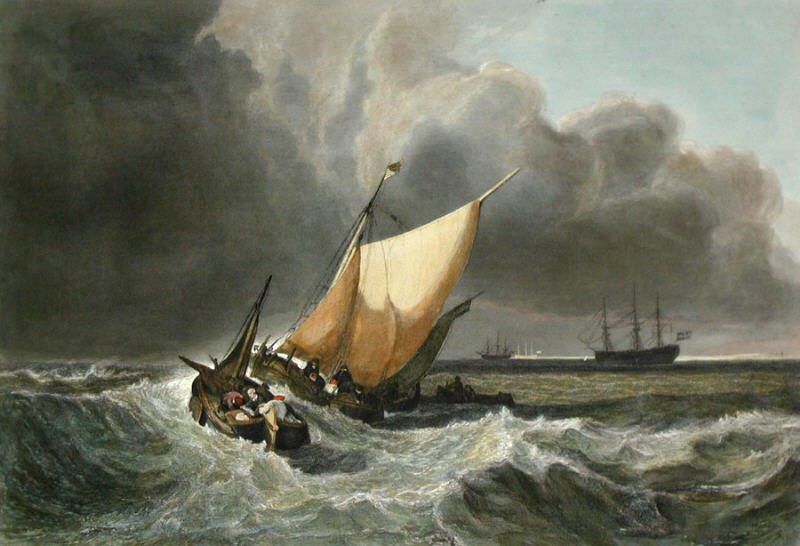
A painting that captures the excitement and danger at sea in the 17th Century. The spotlight ship on the right is a light Dutch fishing vessel called a kaag. It shows one of the most difficult sailing maneuvers in which vessel sails into the wind directly as it can without causing sails to flap uselessly. An image showing and boosting Dutch prosperity and the endurance of her people, this would have stirred up the pride of the Dutch viewers. I find it very interesting to see people on the larger ships on the left having a tough time barging through the sea, it almost seems that they are giving up their mother boats while the Dutch sailors battle the raging sea.
Having painted a total of 19,000 pieces, J.M.W. Turner was a master of watercolors. However, in his early days, he did made studies of a lot of the masters works. Yet, he would not settle on merely copying the masters. He would use his own painting techniques and improve the composition and lighting of his paintings to outrun the masters because he could. This was one of the painting he studied and you can compare it with Turner's
Dutch Boats in a Gale: Fishermen endeavoring ti put their Fish on Board, 1801.

John Martin (British, 1789-1854)
The Destruction of Tyre
Oil on canvas, 1840

This painting reminded me of The Day After Tomorrow where a surge of water destroys the buildings of a great civilization and men are rendered helpless against the forces of nature. The wave on the right has an almost skull-like feature, intensifying the unforgiving devastation brought upon mankind. Helpless and half in the water, the soaked woman can only raise her hands in despair which is only answered by the blazing lightning that pierces through the blood red sky.
Gustave Doré (French, 1832-1883)
The Scottish Highlands
Oil on canvas, 1875

So I was walking around with my camera sticking out and snapping pictures, then this security guard yelled "Sir, you are standing to close to the painting" while I was like a meter away from the painting. So I walked up to him and tried to engage in a friendly conversation. Turned out he wasn't any grumpy old man. He gave me a brief tour around the museum and showed me his favorite painting. Yes, the Scottish Highlands! So my plan is to go to the highlands and find a spot that looks like this painting and snap a few shot for him : )

Dale Chihuly (American, 1941-)
Chandeler: Campiello Remor #2
Glass, blown, cut, assembled, 1996

What can I say, this is just pure beauty by rearranging 243 individual pieces of blown glass and forming this magnificent shape. If you are having a deja vu feeling, well, you probably have seen it at the Victoria and Albert Museum in London.

Frank Gehry & (American, 1929-)
Center for the Visual Arts, University of Toledo, Toledo, Ohio, USA
1992

I ended the my Toledo museums experience by admiring the facade of the Frank Gehry building and wondering why this is so different from the rest of his works.